
Adaptive cycling training
Adaptive cycling training, explained
Adaptive training means your plan responds to you — your recovery, your available time, and your recent activity — instead of forcing you to follow a fixed schedule that ignores real life.
What adaptive training means
Traditional training works from a calendar: a coach or template lays out weeks of sessions in advance, and your job is to execute them. It is a clean idea, and it works well when your life is predictable.
Adaptive training flips the order. Instead of asking “what does the plan say I should do today?” it asks “given how I am right now and what I have done recently, what is the best thing to do today?” The plan becomes a living thing that responds to your real state rather than a fixed contract you are always slightly failing.
Why static plans often fail
A static plan is a prediction. It guesses, weeks ahead, exactly how recovered you will be and how much time you will have on a given Tuesday. Those guesses are usually wrong, because life intervenes — a bad night’s sleep, a work crunch, a sick kid, an unplanned trip.
When the plan and reality diverge, most riders fall into one of two traps: grinding through a hard session their body is not ready for, or skipping it and feeling like they have failed. Repeat that enough times and the plan quietly falls apart. The problem is not discipline — it is that the plan never accounted for a normal life in the first place. It is the most common reason riders go looking for a TrainerRoad alternative — not because the workouts are bad, but because a fixed schedule is hard to keep in step with an unpredictable week.
What the recommendation adapts to
A good adaptive recommendation weighs several inputs, not just your training history.
Recovery
Sleep, soreness, and how your legs feel determine whether today should push or restore.
Available time
A 40-minute window and a free morning call for different sessions. The recommendation respects the clock.
Recent training
What you have done over recent days shapes what makes sense next — and what would be too much.
Non-cycling activity
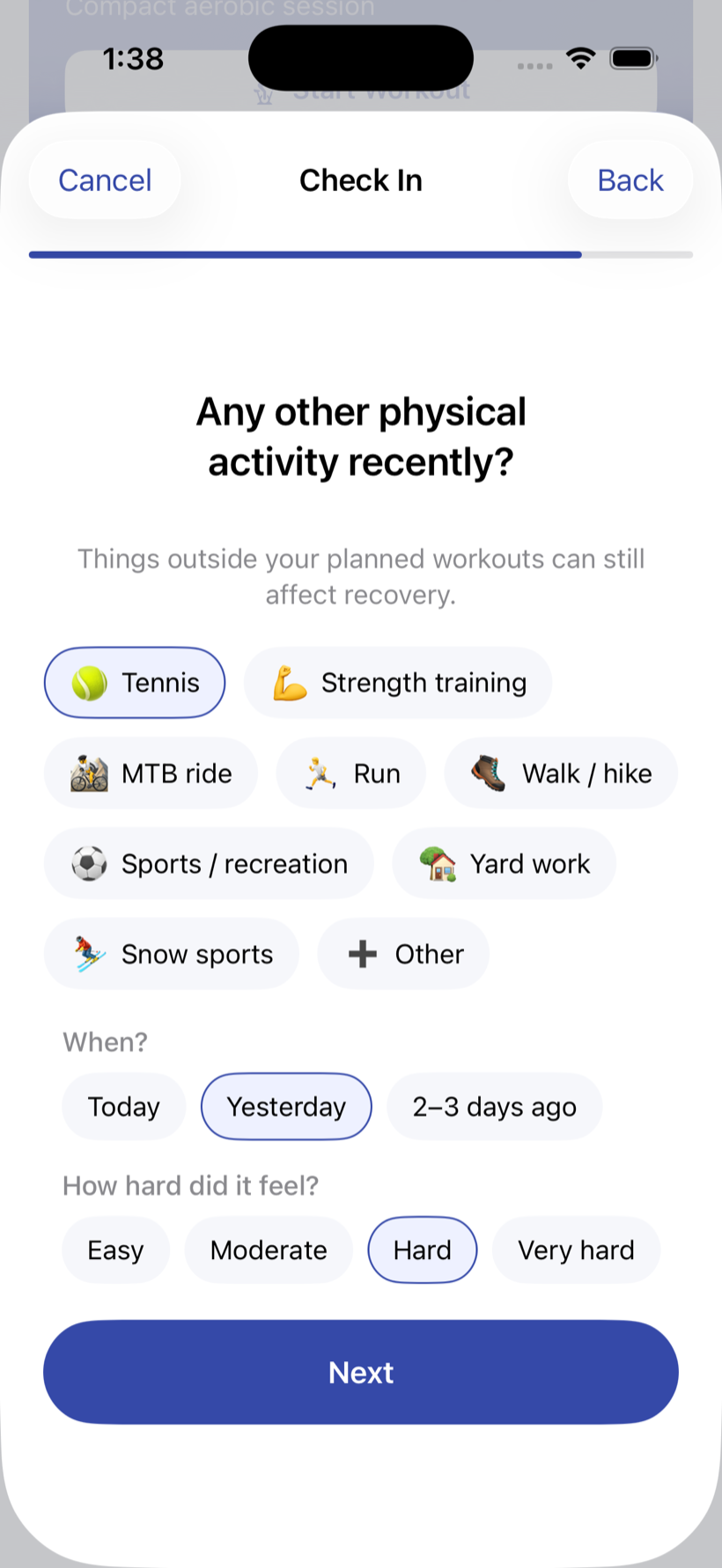
A hard run, a long day on your feet, or heavy lifting all add load your legs still have to absorb.
Motivation
Some days you have the appetite for hard work; some days you do not. The recommendation accounts for it.
What is coming next
Knowing a big block — or a trip — is ahead helps the plan set you up rather than dig a hole.
Examples of adaptation
Plan says: VO2 intervals
You slept four hours and have a sore throat → the app recommends an easy spin or a rest day instead.
Plan says: 45-minute endurance
A meeting canceled and you feel fresh → it offers a longer, more productive ride to use the time.
Plan says: rest day
You feel great and have a window → it suggests a quality session so you do not waste good form.
Plan says: hard group ride
You ran 10k yesterday and your legs are heavy → it steers toward something your legs can absorb.
This is the same engine behind our adaptive cycling coach app — a daily decision that keeps you training through the weeks that would otherwise derail you. And adaptive does not mean losing control: when you want to choose for yourself, a full workout library with editable templates is always there.
Frequently asked questions
- What is adaptive cycling training?
- Adaptive cycling training is an approach where your workouts adjust to your current state — recovery, available time, recent training, and life stress — rather than following a fixed schedule written weeks in advance. The aim is to train appropriately for the day you are actually having.
- Why do static training plans often fail?
- Static plans assume every week goes to schedule. Real life rarely cooperates: sleep, work, travel, illness, and other activities all interfere. When the plan and reality diverge, riders tend to either overreach on tired legs or abandon the plan — both of which hurt consistency.
- Does adaptive training mean doing less?
- No. It means doing the right amount for the day. Sometimes that is harder than the plan called for, sometimes easier. The goal is appropriate training that you can sustain, which over time supports consistency.
- How does SmarterTraining adapt?
- A short daily check-in captures how recovered you are, how much time you have, and what is happening outside cycling. SmarterTraining weighs those inputs along with your recent training and recommends a session that fits today — then adjusts again tomorrow.
- Can I still choose my own workouts with adaptive training?
- Yes. Adaptive training changes the default, not your freedom. In SmarterTraining, the recommendation is a starting point: you can browse the full workout library — recovery through VO₂ max and muscular endurance — pick a duration, or customize any session. The app simply makes sure you always know which choice fits today best.
- Is it free to try?
- The workout library and execution features are free. Adaptive coaching — the daily check-in and today’s recommendation — is available with Pro, which has a 7-day free trial. That is enough to experience adaptive training first-hand.
Experience adaptive training
Complete a check-in and see how a plan that adapts to you feels in practice. Workouts are free; adaptive coaching has a 7-day free trial.
Keep exploring
Indoor Cycling App
What SmarterTraining is, how daily recommendations work, and smart-trainer compatibility.
AI Cycling Coach App
AI-assisted coaching that trains around work, family, travel, and fatigue.
Zwift Training Plan
A complete adaptive training app that runs your workouts on its own — and can sit alongside Zwift when you want virtual riding.
TrainerRoad Alternative
A respectful comparison for riders who want coaching that adapts to real life.
TrainerRoad vs Zwift
Workouts vs virtual riding — what each platform is for, and where SmarterTraining fits.
Best Indoor Cycling Apps
An honest 2026 overview of Zwift, TrainerRoad, TrainingPeaks, Wahoo SYSTM, and more.
Free cycling calculators
FTP Calculator
Estimate your FTP from a 20-minute test and get your seven cycling power zones in watts.
W/kg Calculator
Turn FTP and body weight into watts per kilogram and see where you sit against performance categories.
Cycling Power Zone Calculator
Generate a full training-zone table from your FTP — percentages, watt ranges, and what each zone trains.