
How does SmarterTraining work?
SmarterTraining is adaptive indoor cycling coaching that fits training around your real life. Here is the whole loop, screen by screen: you set your goals and approach, check in each day, get one workout that fits, ride it with trainer guidance, and the plan adapts based on what actually happened.
SmarterTraining is adaptive indoor cycling coaching for people with real lives. Instead of handing you a fixed plan and hoping your week cooperates, it decides what to do today based on how you are actually doing. Here is the whole loop, screen by screen.
You tell SmarterTraining your goals and how aggressively you want to train. Each day you do a quick check-in — how your legs feel, your energy, what life is throwing at you — and it gives you one workout that fits the day, with the reasoning behind it. You ride it on your smart trainer with the app controlling resistance, get a clear summary afterward, and the plan adapts based on what actually happened. The loop repeats, and the coaching gets more tailored over time.
The daily loop, in one sentence
Check in, get the right workout for today, ride it, reflect — and let the next day’s plan account for all of it. Most training apps stop at “here is your plan.” SmarterTraining is built around the idea that the plan should respond to the week you actually got, which is the part that decides whether busy riders stay consistent. We go deeper on the reasoning in why adaptive systems outperform rigid schedules.
1. You set your goals and approach
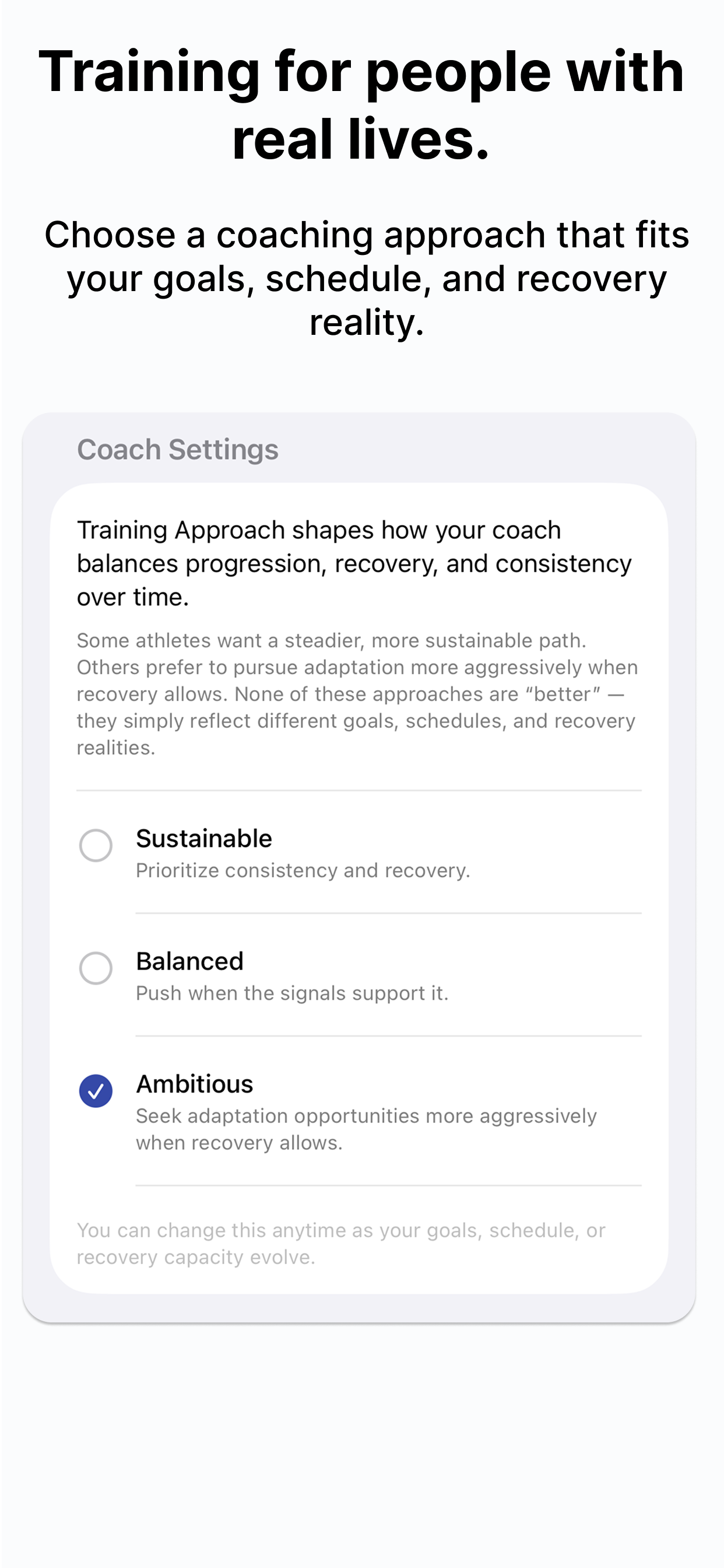
Before the day-to-day starts, you tell SmarterTraining what you are training for and how you want it to balance progression against recovery. The training approach setting is the main dial: choose Sustainable to prioritize consistency and recovery, Balanced to push when the signals support it, or Ambitious to chase adaptation more aggressively when your recovery allows. None of these is “better” — they reflect different goals, schedules, and recovery realities, and you can change the setting any time your life does.
2. Each day, you get one workout that fits
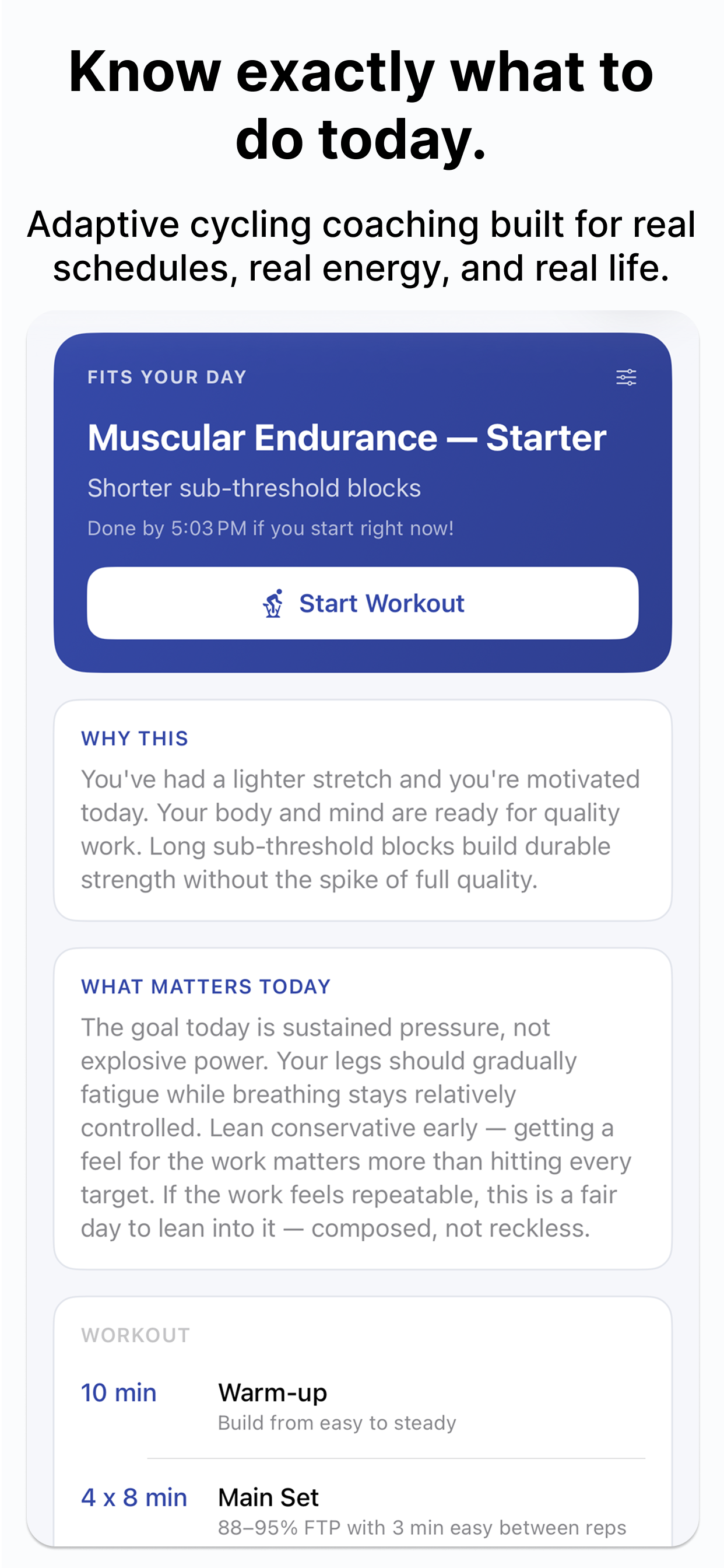
This is the screen you will see most. After a roughly 30-second check-in — how your legs feel, your energy, sleep, and whatever life is adding that day — SmarterTraining recommends a single workout built for the day you are actually having, and tells you when you would be done if you started now. It does not just name the session; it explains why this and what matters today, so you understand the intent rather than blindly following targets.
In the example below, a lighter recent stretch and good motivation lead to a muscular-endurance session of sub-threshold blocks — 4x8 minutes at 88–95% FTP with easy spinning between — with a note to lean conservative early and feel out the work before committing. On a tired or time-pinched day, the same check-in produces something shorter and easier instead.
3. You ride it with guidance
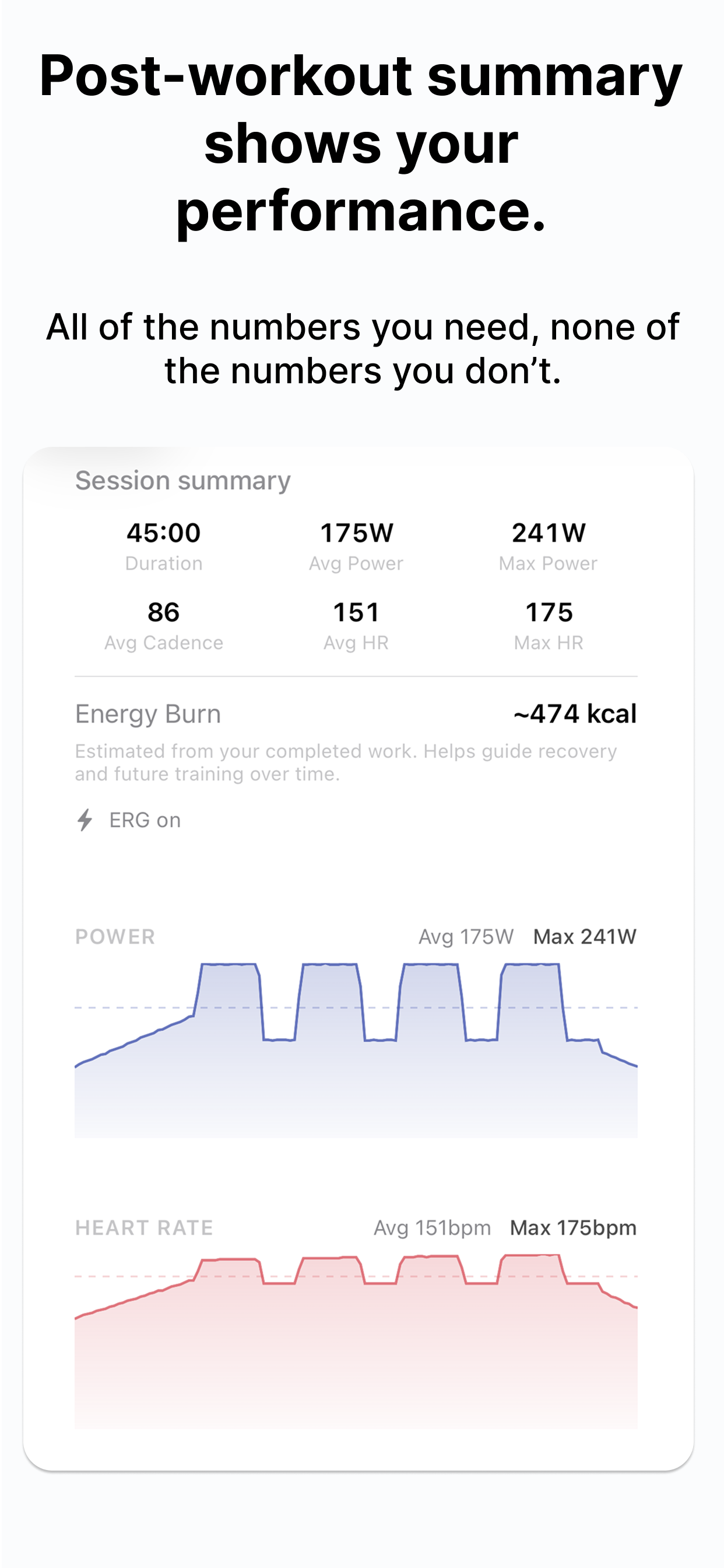
Tap start and the app runs the session on your smart trainer. It shows a clear target for the current interval, your live power, heart rate, cadence, and speed, and where you are in the set — “Interval 2 of 4,” time left in the effort, what is coming next, and your projected finish time. With ERG mode on, the trainer holds the target watts for you so you can just pedal; flip ERG off when you want to control the resistance yourself, and skip an interval if the day calls for it.
4. After the ride: a summary and a check-in
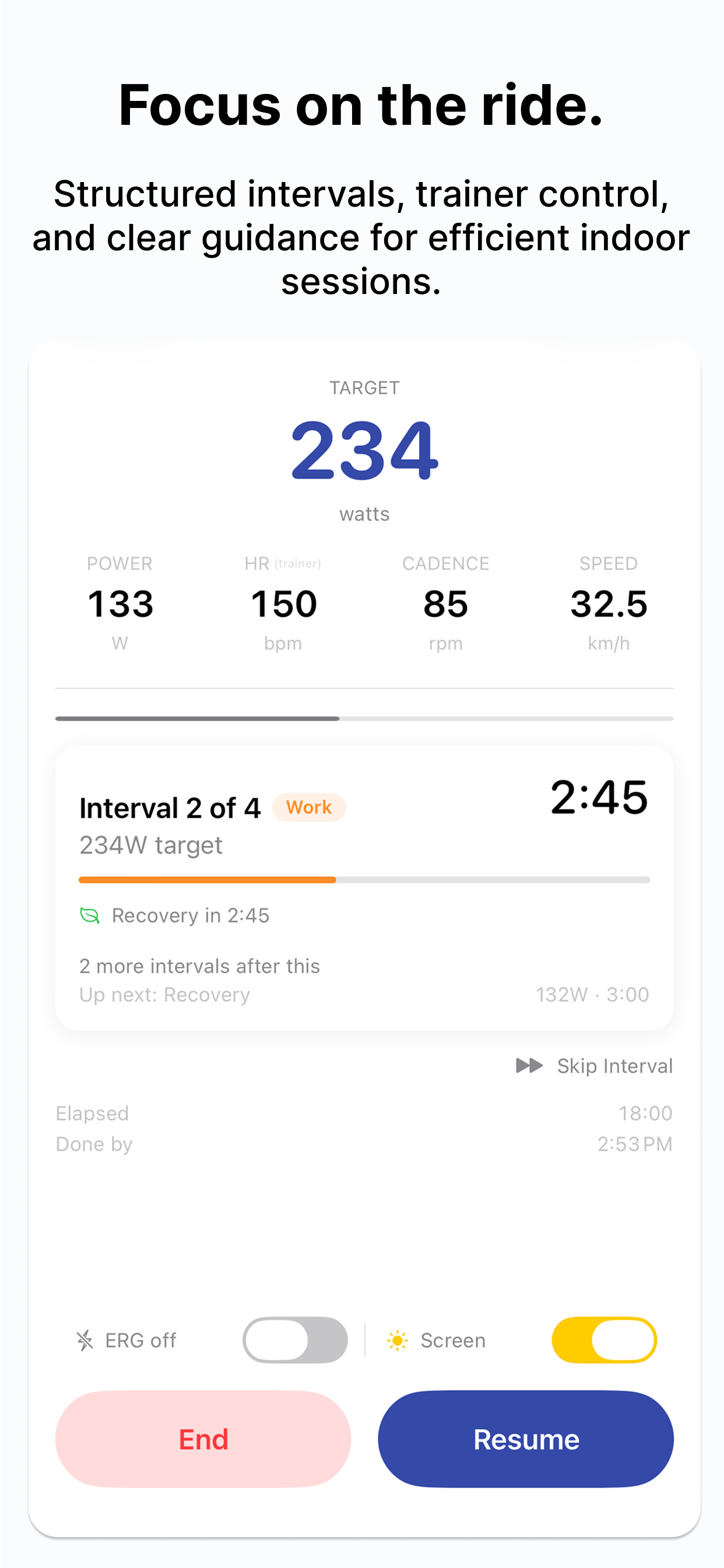
When you finish, you get a session summary with the numbers that matter and none of the clutter: duration, average and max power, average and max heart rate, cadence, an estimated energy burn, and power and heart-rate traces for the ride. It is enough to see how the session went without drowning you in metrics you will never act on.
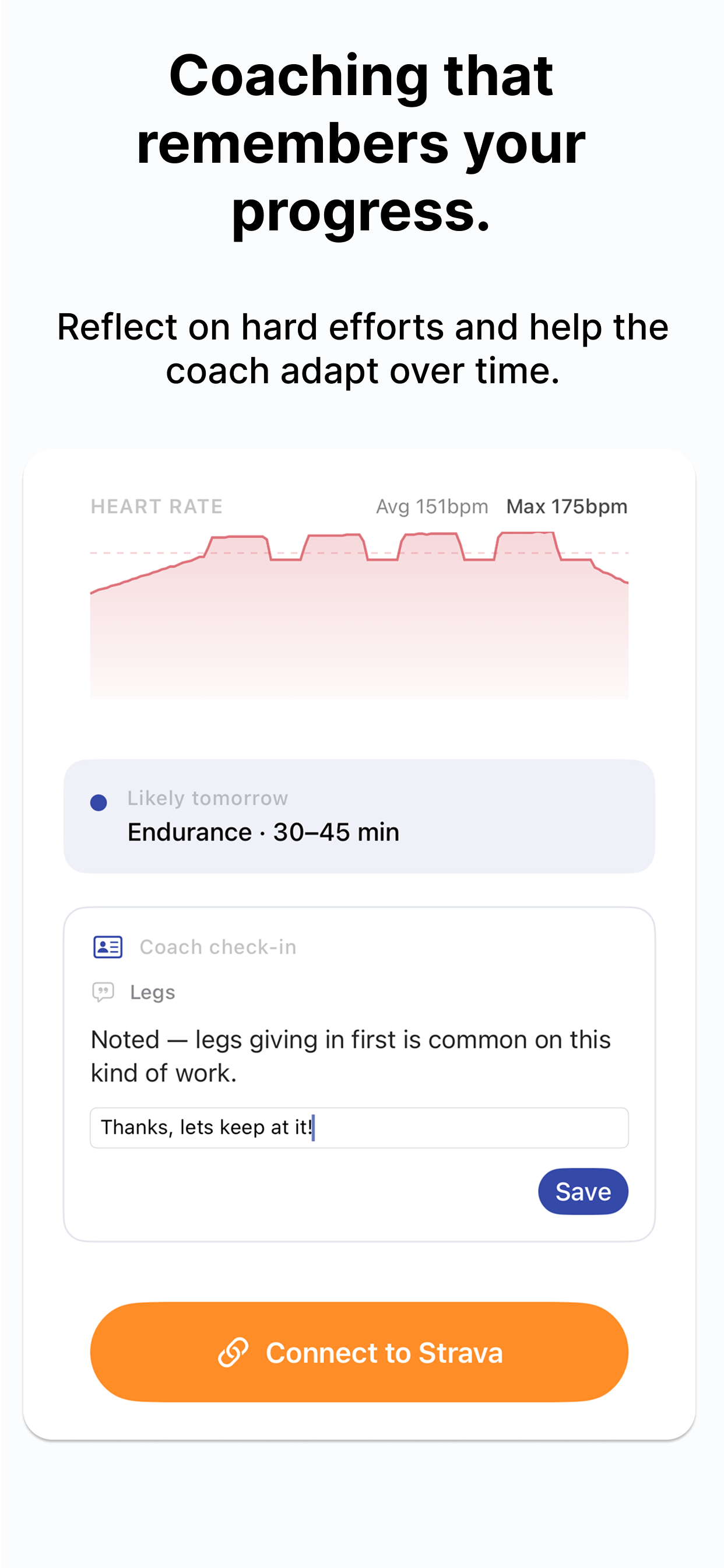
After harder efforts, the coach checks in: a short reflection on how the work felt and a quick note back. That feedback is not decoration — it feeds the next recommendation, and it is also where you can connect Strava so your rides flow through to the rest of your training picture.
5. The plan adapts over time
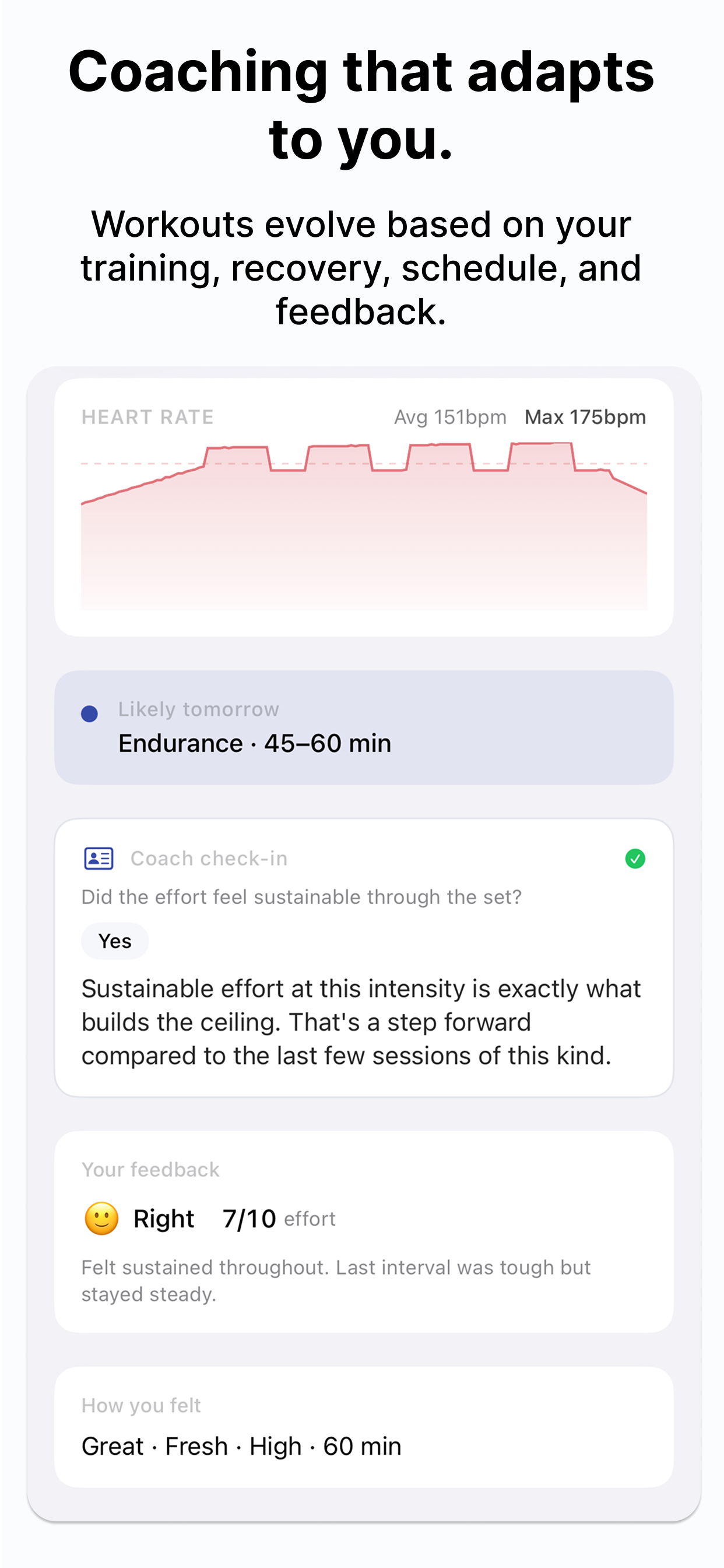
Each ride and check-in becomes context for the next one. If a session felt sustainable at a given intensity, that is a signal you can handle a bit more of it; if your legs gave out early or the week was rough, the plan eases off rather than pretending the fatigue is not there. Over weeks, the recommendations track your real trajectory — what you completed, how it felt, and how recovered you have been — instead of a schedule written before any of it happened.
This is also why a missed workout is not a problem to apologize for. A skipped Tuesday simply becomes part of the picture the app reasons from — the plan reshapes around it, the way a good coach would. For more on why that matters when you only have a few hours a week, see how to stay fit on 4–6 hours a week.
How SmarterTraining thinks about this
The thread running through every screen is the same: the best workout is the one that fits the day you are actually having, not the one a plan guessed at weeks ago. SmarterTraining looks at the combination an attentive coach would — your recent training, how you say you are feeling, your goals, and the time you have — and makes one clear recommendation, with the reasoning attached.
It will not promise to turn four hours a week into ten, and it does not try to. The goal is consistency without guilt or guesswork: a plan you can actually finish, that bends around real schedules and real energy, and that gets more tailored to you the longer you use it.
Takeaway
Takeaway: SmarterTraining is a daily loop — check in, get one workout that fits today, ride it with trainer guidance, reflect, and let the plan adapt. It is coaching built for real schedules and real recovery, not a fixed block you have to live up to.
Keep reading
- Adaptive Training
How adaptive coaching, flexible plans, and AI guidance keep your training on track when life keeps moving the goalposts.
- Why adaptive coaching matters for busy athletes
Why a plan that adjusts to the week you actually got beats a fixed block for time-pressed riders.
- How to stay fit on 4–6 hours/week
How to hold strong fitness on low volume by protecting two real quality sessions and keeping the rest genuinely easy.
Frequently asked questions
- Do I need a smart trainer to use SmarterTraining?
- A smart trainer gives you the full experience — power targets, ERG control, and accurate post-ride numbers. SmarterTraining connects to your trainer and sensors over standard Bluetooth, controls resistance during intervals, and reads power, heart rate, cadence, and speed. You can also turn ERG off at any time and ride the targets manually.
- How is SmarterTraining different from a static training plan?
- A static plan is written in advance and assumes your week arrives as planned. SmarterTraining decides each day based on a quick check-in, your recent training, and your goals — so a bad night of sleep, a stressful workday, or a missed session changes today’s recommendation instead of leaving you to improvise or fall behind.
- Do I have to check in every day?
- No. The check-in takes about 30 seconds and makes the recommendation sharper, but you can open the app and take the suggested workout without it. The more context you give it — how your legs feel, your energy, sleep, work stress — the better it can match the day.
- Is SmarterTraining only for indoor cycling?
- It is built around structured indoor sessions on a smart trainer, where it can control resistance and guide each interval. That is where most time-crunched riders get the best return on limited hours, and it is the part of training the app focuses on.
Train smarter, not more
SmarterTraining builds a cycling plan that adapts to your fatigue, schedule, and goals — so a missed workout never derails the week. Download the app to get started.
Related reading
Why adaptive systems outperform rigid schedules
A rigid schedule is only as good as the week you actually get, and most amateurs do not get the week they planned. Here is why an adaptive system — one that decides each day from what really happened — produces more usable training over months, and when a fixed plan still makes sense.
Why time-crunched athletes need different training logic
A time-crunched plan is not a big plan with the volume trimmed off. When hours are the hard constraint, the priorities invert: intensity carries more of the load, recovery cost matters more per session, and one missed ride is a quarter of your week, not a footnote. The logic itself has to change.
How to stay fit on 4–6 hours/week
Four to six hours a week is enough to hold genuinely strong cycling fitness — if you spend it well. The riders who fade on low volume waste it on medium-hard junk; the ones who hold form protect two real quality sessions, anchor one longer aerobic ride, and keep everything else easy. Here is the structure.